
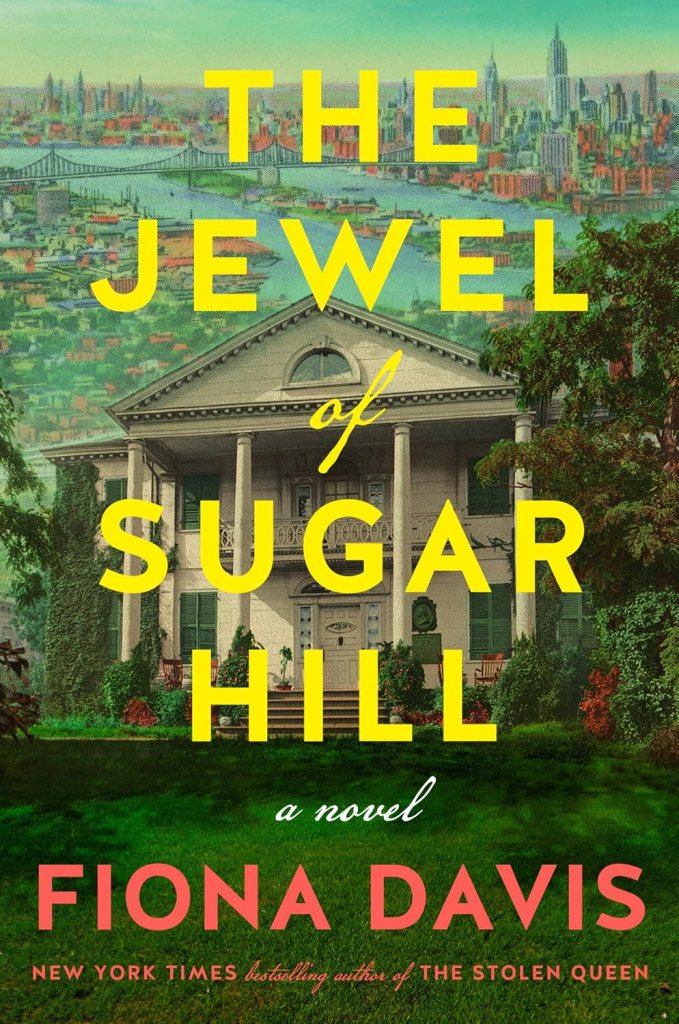
In nearly all of Fiona Davis’ novels, she masterfully ties a New York landmark to the story’s centerpiece through multiple timelines and does so seamlessly (one is even set in Egypt and NYC). I love how she does this. She clearly has a great talent for it. But there is something I love even more about how she writes.
I love the resilience, fortitude, strength, and brilliance of the women she writes. Davis’s female characters refuse to be confined by custom.
In The Jewel of Sugar Hill (set for a January 26, 2027 release), she successfully does it again. With endless thanks to NetGalley for the advanced copy, I had the good fortune to read a terrific story of two women – Eliza Brown Jumel and Abby Dorrance – set in the early-to-mid 19th century and modern-day New York, respectively.
Each of these women fit the characteristics I noted a moment ago, and both were a joy to get to know. However, full disclosure: I loved learning about Eliza and her history, and even the distracted tangents I took looking her up and reading her real-life story. What a story she is.
During 19th-century life, it was the prevailing opinion that men were the more capable decision makers. The identity of women – particularly their legal identity – was absorbed by their husbands, and a woman’s station was beneath that of men.
However, Eliza Jumel did not subscribe to that way of thinking. She did not allow herself to be bound by the limits created for women by the males’ idiotic and chauvinistic way of thinking.
Eliza freely and boldly challenged the gender roles of the time. Her intellect towered over many of the men in business, leading her to become the wealthiest woman in New York. Through her own providence, she cultivated the fledgling businesses of her husband Stephen, as well as creating additional ones in his absence. He, sadly, was foundering in his other ventures across the Atlantic in France.
In Davis’ modern-day storytelling, Abby Dorrance also met with more than her fair share of male interference in both her career and personal life. Although to a lesser extreme – but not a lesser degree – she met with similar challenges. However, hers did not come from society as much as it did from her own family.
Davis has such a grasp on these historic landmarks that serve as central characters in her stories. You’ll find there is a great history of the Morris-Jumel Mansion woven throughout. Although she admits to taking some liberties with the life of Eliza Jumel, she does so to “capture the essence of the woman behind the myth.” You will find, in reading The Jewel of Sugar Hill, she was resoundingly successful in doing so.
If you are a regular reader of Davis’ novels, then it makes me very happy to share that you have much to look forward to. She does not disappoint, and in the way only Fiona Davis does, she tells a terrific story — and tells it exceptionally well.
Again.
There are reasons why she and Fredrik Backman are my favorite authors. She continues to strengthen her place at the top with me, even more so with The Jewel of Sugar Hill.
I am envious of every one of you who gets to read it for the first time.

