Words. Terms. Names. Expressions. Locution. Vocable.

WORD
/wərd/

noun
plural noun: words
1. 1.  a single distinct meaningful element of speech or writing, used with others (or sometimes alone) to form a sentence and typically shown with a space on either side when written or printed.
synonyms: term, name, expression, designation, locution, vocable;

One of my favorite parts of reading is constantly learning new words. I often make note of them then look them up either at the time of reading, or later that same day.

After a while I started thinking, why not compile them?

Lately, I have found myself looking up its definition straight away on my eReader and highlight the word. When I finish the book, I put the list together.

These are words that I …

  1. Never heard before
  2. Words I have heard and possess only a vague understanding of their meaning based on the context in which they’ve been written and
  3. The most frustrating of the lot – the words I know I know the meaning of until I actually look them up only to realize I was wrong all along

You will find them here and at the bottom of the blog book review I post.

Dear Me, Get Outta My Way. Love, Me

Writing about a self-help book is an awkward experience.  I am exposing my own weaknesses online, while it is also terribly subjective.

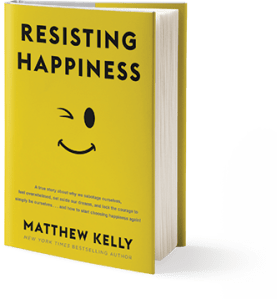
Nevertheless, I found Resisting Happiness to run both hot, and cold.  But since I only care about positives, that’s what my focus will be on.  Written by Matthew Kelly, Resisting Happiness made me stop, and truly think, of how I live my life.

First as a man who believes in God, and next as a Catholic who could use a little work at his practice of faith.

But it wasn’t until I became acutely aware how much I need to put more stock in myself, and less in the expectations of others, that this book had its biggest impact on me.  Basically, I need to become a better version of myself.

This Catholic-based self-help book was a recommendation from a friend of my fiancée and mine. In her text, she sent a picture of her copy with nearly 90+ sheets dog-eared.  The book is 186 pages, people.  She was diggin’ it.

I gave it a go and enjoyed it, too.  In the interest of brevity, I will bullet point my favorite thoughts.  Some triggered an internal “OMG, yes!” and, others serving as gentle reminders.

  1. Everyone I meet is fighting a hard battle.  Be kind to them.
  2. Be gentle with ourselves.  If we cannot forgive ourselves, we will struggle to forgive others.  When we are gentle and patient with ourselves, we develop awareness, and awareness breeds compassion.  Everyone needs a little compassion.
  3. Take note of the moments when I was challenged to grow.  Be mindful of the decisions I made which left me in need of healing (this one is harder than it looks to me).
  4. Thy will be done.  I would pretty much call this an absolute imperative if I want to be better at the Catholic thing.
  5. It only takes 10 minutes a day to pray.
  6. Our lives change when our habits change.
  7. Wherever we find excellence, we find continuous learning.
  8. How many Sundays do I have left?  With the average life expectancy of 78.74 years, I have 1,536 left.  Life is short.  Never waste a day – Sunday or any other.
  9. Any type of inner slavery limits our ability to love ourselves, to love our God, and to love others.
  10. Delay gratification.   All of life’s regrets come from not having the discipline to overcome resistance and delay gratification in order to build a bigger future.

Additionally, I was influenced by the things people wished they had done when they learned they were dying.  He gives us 24, but there were only five that hit me hardest.

  • I wish I had paid less attention to other people’s expectations
  • I wish I hadn’t spent so much time worrying about things that never happened
  • I wish I had cared less about what other people thought
  • I wish I had realized earlier that happiness is a choice
  • I wish I had taken better care of myself

Don’t get the wrong idea here.  I am not about to light an incense candle and dive impetuously into the glory and beauty of life and make a hundred changes.  What it does mean, however, is that as a man in his 40’s I can now have a deeper appreciation of those regrets.  It means that I have learned, once again, that I need to be patient with myself.  Lord knows, I need to not be as hard on myself as I am.  Possibly kinder?  Maybe more aware?  Then who knows what the future will hold.  Maybe this wonderfully blessed life of mine can become even better over time …

… provided I get out of my own way, and no longer resist my own happiness.

The Winter in Anna: Dark. Painful. Beautifully Written.

To be drawn into a well-written story is the very reason I read books.  To read fiction and believe it as nonfiction.

The Winter in Anna was one of those well written stories.

I will tell you, I shudder to think of the dark places author Reed Karaim had to go in order write this book.  Yikes.

You see, on page one in paragraph one Anna commits suicide in a manner I would have never imagined.  I literally needed to step away from the book before turning to page two.  Yes, the shock of the act was part of it, but what was most dominant was the sorrow that washed over me.

Her death was horrible.

Why choose that way?

My God, how painful!

Then 256 pages later, there was closure, and understanding.

*                      *                      *

TheWinterinAnnaImageAnna.  This beautiful and unspeakably pained woman.  How my heart hurt for her and yet how many times I admired her, all at the same time.

Karaim wastes no time in showing us Anna is a woman of many scars – physical and emotional.   As dark as this may sound, his ability to take that pain and show its evolutionary process over the years was something I really enjoyed about his writing.

She struggled from her teenage years until she decided to die, but her role as mother, and the responsibility of giving her children the life they deserved was a relentless pursuit of hers. At least, that is my opinion.  I’m sure one can make an argument to the contrary, but all in all she adored, and did all she could, for those kids of hers.

Our narrator is Eric. He tells us of Anna’s suicide, shortly after he learns about it himself.  For the next 250+ pages, he recalls his time in getting to know her, or rather, as much as she would permit him to know.  When she would close the emotional door on him, he told us more of himself.

I have to tell you, when we see Eric as a 20/21-year-old kid, he isn’t very likable.  Not at all.  Furthermore, I don’t think he realizes it.  Today, it is a mature Eric that tells us this story and I found him very easy to like.  He grew into a good man.  I have a sneaking suspicion that was the author’s intent.

When the time came to close the book, and the story had been told, I wanted to know them both.

I wanted to visit Anna’s final resting place.  To sit with her, pray she found peace, and trace the outline of her headstone (similar to that day she and Eric visited the cemetery).

On the other hand, the testosterone driven part of me wanted to save her.  To locate the nearest phone booth, change into my cape and fly into that woeful motel room.  I would swoop in and whisk her away.  Fly her off to paradise … or Bismarck, ND … either/or… just somewhere else, with the hope she will find reason to live for another day, week, month, year …

But the main problem with the latter is this: “Who am I to interfere with someone’s decision on life or death?”

No one.  Besides, I can’t fly.  Therefore, it’s moot, and I remain on the outside looking in.

I do not want this to sound like I am giving her suicide a shrug of the shoulders and call her a victim, though.  The decisions Anna made in her life were her own.  She is responsible for her life.  But I will also tell you there were a number of circumstances that were not her doing that had a serious impact on her well being.  I think it is how we react to tragedy – and all of life’s events – that serves as the chisel, which carves the sculpture of who we are to become over the years.

You can argue she should have been a better mother, but I would contend she did put the kids first.  There were times that may have been a significant challenge but she took responsibility for herself as a mother.

My fiancé is reading this now and so far her reaction is markedly different from mine.  Only halfway through, it has not gripped her yet.  This is equal parts surprising and interesting to me because we are usually on the same page when it comes to books.  We like and dislike the same ones.  But every now and again one comes along, and we differ.  I very much look forward to her finishing. I want to see if her opinion changes.  I want to talk at length about the book I enjoyed so much.

I reckon that is the telltale sign of a good book, don’t you?  The kind that stays with you days after you have finished it?  The kind you cannot wait to talk to others about ad nauseam.

I’d say so about The Winter in Anna.

This is the second book by Reed Karaim.


Words I learned while reading:  As I have said in a previous blog, one of my favorite parts of reading is constantly learning words I have either (a) never heard before (b) words I have heard and possess only a vague understanding of and (c) words I thought I knew but discovered I didn’t.  Here is the contribution that I received from Reed Karaim’s The Winter in Anna.

Furtive – attempting to avoid notice or attention, typically because of guilt or a belief that discovery would lead to trouble; secretive.  Prow – the forward most part of a ship’s bow that cuts through the water.  Desiccated – lacking interest, passion, or energy AND dehydrated or powdered.  Profligacy [prof-li-guh-see] – a noun meaning reckless extravagance or wastefulness in the use of resources.  Archipelago* [ahr-kuh-pel-uh-goh] a large group or chain of islands or any large body of water with many islands.   Chasm* – an adjective that is a profound difference between people, viewpoints, feelings, etc.  It can also mean a sundering breach in relations, as a divergence of opinions, beliefs, etc., between persons or groups.  Obsidian – a hard, dark, glass-like volcanic rock formed by the rapid solidification of lava without crystallization.  Somnolent – sleepy, drowsy.  Torpor – a state of decreased physiological activity in an animal, usually by a reduced body temperature and metabolic rate. Torpor enables animals to survive periods of reduced food availability.  Photogravure /fōdəɡrəˈvyo͝or/ – an image produced from a photographic negative transferred to a metal plate and etched in from which ink reproductions are made.  Staccato – with each sound or note sharply detached or separated from the others.  Scimitar /ˈsimədər,ˈsiməˌtär/ a short sword with a curved blade that broadens toward the point, used originally in Eastern countries.  Crenellation – a pattern along the top of a parapet (fortified wall), most often in the form of multiple, regular, rectangular spaces in the top of the wall, through which arrows or other weaponry may be shot, especially as used in medieval European architecture.  Phantasmagorical [fan-taz-muh-gawr-ik, -gor-] (sometimes phantasmagorical) having a fantastic or deceptive appearance, as something in a dream or created by the imagination.  Sere dry; withered.

For Me? You Shouldn’t Have … But I’m Glad You Did.

What do you write when you don’t know what to write?  Where do you start if you don’t know what you want to write about but deep down inside all you want to do is punch the keys on the keyboard and make words that flow together into a good story that is entertaining enough to read?  It’s frustrating.  Very frustrating actually and I am not sure how to bust out of it.  One way, I suppose is the stream of consciousness writing.  So if this goes off kilter in some way, you’ll know that

A book group friend of my fiancee’s, whom I consider my friend too, asked me about this the other night.  She suggested I consider writing as a gift to myself.  It immediately struck me as a great idea, a great way to exercise my self esteem and do something for myself that costs nothing but a little time

It was – no, it IS, an idea that I love…and so perhaps that will be my approach for a while.  Perhaps I should also not worry too much about posts that HAVE TO BE perfectly written, or written for any one particular person or one particular audience.  I have heard when people write they generally have someone in mind they write for.  I get that.  I’m guilty of that.

I just need to start making that person me.

If you read the blog before this you know I am a fan (new fan) of Jenny Lawson.  I read her second book first and am reading her first book now and in it she says bloggers are pretty much broken people.  OK, not all bloggers are broken.  But many are.  In some regard, I get that.  I agree with that.  I am that.  But, we are all a little broken somehow, someway so it is not an insult or a bad thing.  At least, not in my opinion.  I may go back and read that part again.  Maybe a couple more times.

But I am still – without a complete in depth understanding of what she is saying – ready to agree with her.  I love Lawson’s blog.  Smart.  Funny.  Random.  Disjointed.  Goofy.  Nonsensical at times.  It speaks to me.  It is a lot of fun to read.  Besides, if it turns out that my blog is a fraction as funny or as entertaining as hers I would welcome said broken brain with open arms … which in theory is healthy but in actuality, the image is totally gross.

So, you know, here it is, here you go, there it is.  It ain’t much now but hopefully in a few months will be.

I’ll let you know then.

But, until then, I give this to me as my first gift. Happy birthday to me – six weeks late … OR 46 weeks early.

I must remember to send me a thank you note.  Or Aimee.  It was her idea.  Thanks, Aimee.