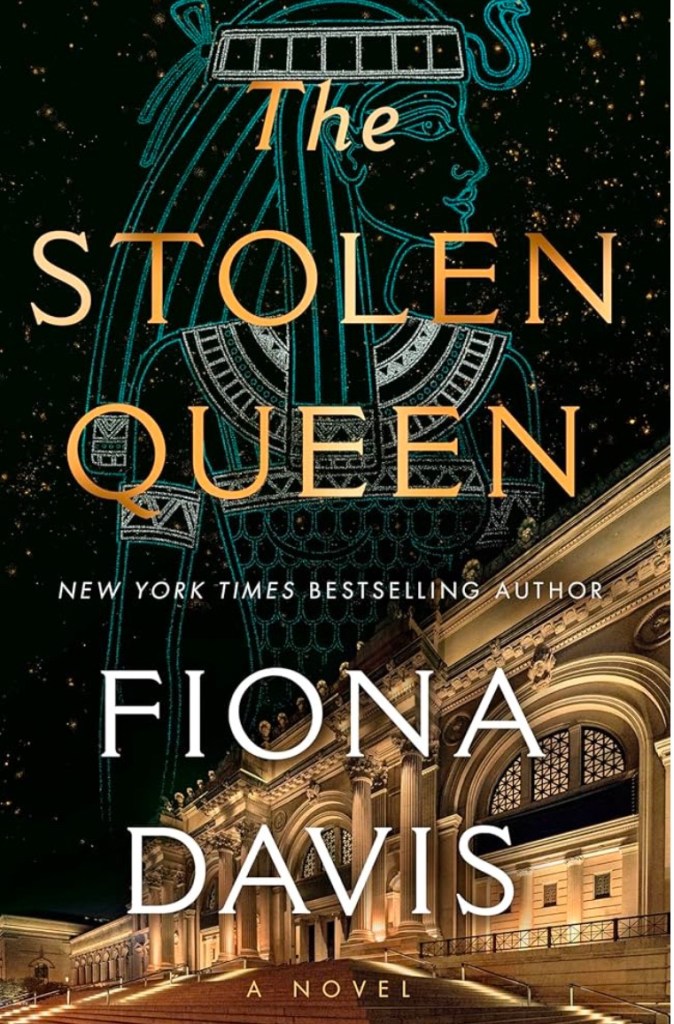
Fiona Davis’ The Stolen Queen

Released January 7, 2025

Not unlike all previous books written by Fiona Davis, she captures a strength and resolve in women that, in my opinion, is far too often understated.

In all eight books she has had published, there is a New York City historical landmark set as the novels centerpiece. These buildings are usually the start of most discussions regarding Davis’ work, and understandably so. Whether it is The Barbizon, The Dakota, or as in The Stolen Queen, the Metropolitan Museum of Art, they’re major players in our story. When she writes she turns brick and mortar into something that lives and breathes. They are expressive characters that leave us with an indelible experience.

But she does so much more than that.

It’s the women. It’s how she writes them.

Davis writes women of strength and character. They are bright and resolute. They show us their vulnerabilities and not once would they be confused as a weakness. They are, and I say this in the most impressive of ways, capable. Capable of reaching heights they work toward.

In The Stolen Queen, Charlotte is our main protagonist and Annie becomes her assistant. These women, like so many she creates, are what I have just described. Both strong, they show their strengths in their own ways.

Charlotte, with her steadfast and determined nature, overcomes a devastating tragedy at a young age. She remained in her profession, in spite of the heartbreaking misfortune and loss she met with in that world. Her research continued and her passion renewed with a theft of an important artifact.

After her loss she lived her life as she chose to. When you consider she was 19 years old in 1938, that, to me, is further testament to her strengths.

Annie, a young and inexperienced woman who played nursemaid to a perfectly healthy but emotionally defective mother, seeks to find her own path. As she did so, I saw in her a perseverance of someone beyond her years. She knows there’s something out there for her. It’s something big and she is relentless in chasing it down.

I have to admit, I went into this one intimidated. I know nothing of, nor have I had a working interest in, Egyptian history. However, to my delight, Davis deftly and easily made that a nonissue.

Throughout the story I was enveloped in her writing style and couldn’t wait to get the next page. Additionally, she continues to master two timelines and pulls them together seamlessly.

The Stolen Queen continues Davis’ terrific run of historical fiction set in New York City.

This woman could make a grocery list gripping.

The only downside I found was, after I finished it, it will feel like forever until her next one.

Talkin’ (re: Reading) Baseball

Ever since I heard of its release, I have wanted to read Molina: The Story of the Father Who Raised an Unlikely Baseball Dynasty.  In fact, there are tons of baseball books I want to read but I never make the time to do so.

The 2017 season will be different.

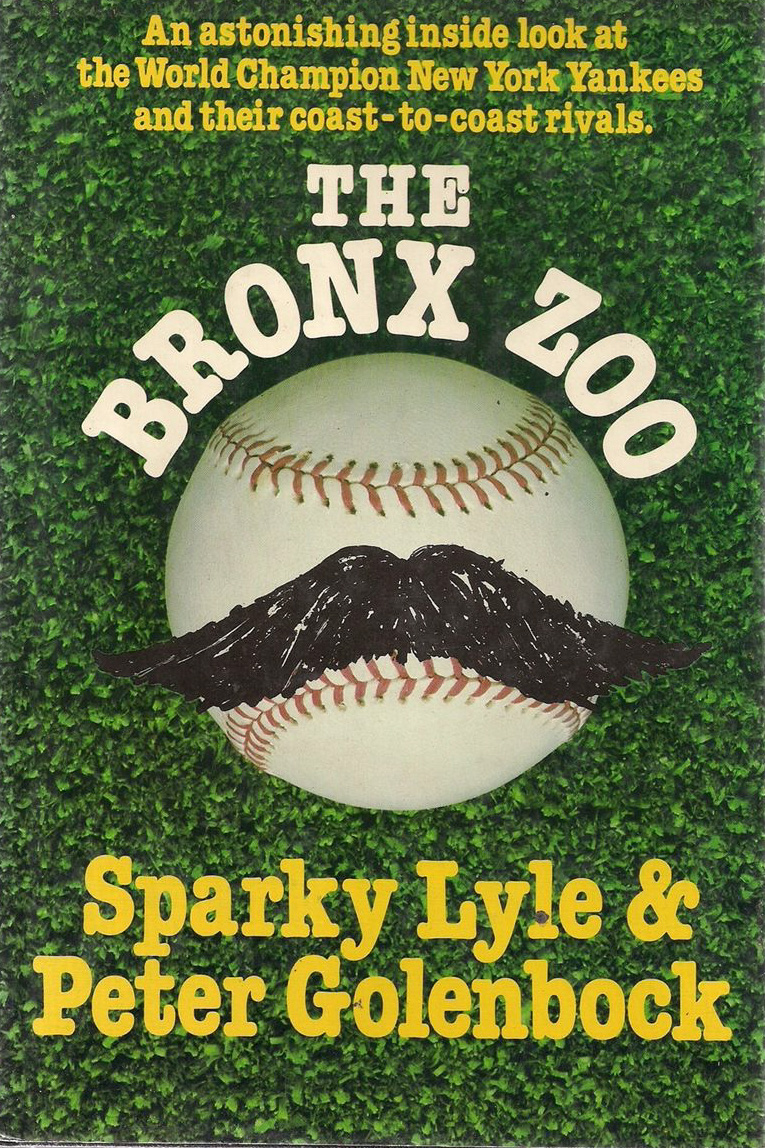
Since I was laid up for a week after knee surgery on May 23, I have torn through four books and am two-thirds of the way through a fifth.  I began with Molina, visited the animals at The Bronx Zoo, cringed at the Yips of a Phenom and rode the busses for a year with Baseball Gospels.  Currently I am avoiding bar fights with David Wells.

First I need to talk about Molina.

molinaTremendous.  Absolutely, positively tremendous.  A book where the heart of baseball, and how baseball was the heart of a lovely family, are beautifully intertwined.

Well written and difficult to put down, Molina’s book is a delightful, and at times emotional, story.  And although our pastime seemed like it was the center of it all, it wasn’t.  A love story, in fact, was.  It was one I felt I could relate to but on a significantly smaller scale.

Bengie, his Dad, his Mom, his brothers, his girls.  It’s a love story of a family in Puerto Rico.  It’s a love story on a workhorse of a baseball diamond, across the street from house he grew up in.  This is not a breakdown of game after game in his career.  In fact, one thing that impressed the heck out of me was the part about winning his first World Series.  Sure it was there, but it didn’t seem much more than a footnote.  Probably because as amazing an experience that was for him, his family was always #1 with him.  I loved that.  I loved that winning the WS was no more than three pages.  But dealing with significant lessons in life regarding his father?  So very many.  I will be forever happy Molina allowed us into his heart, the dugout and his life and equally as happy I finally took the time to read it.  I  hope every baseball fan I know, who appreciates the game and family, follows suit.

Lyle_editedI followed up with The Bronx Zoo and reminisced about my childhood Yankee teams that won the ’77 and ’78 World Series’.  So much fun.  I can see how this was a groundbreaking book in its time.  Plus, when you consider its author and Cy Young Award winner Sparky Lyle was a childhood favorite of mine and a bit of a local hero (Somerset Patriots), how could I not?

Next up, The Phenomenon: Pressure, the Yips, and the Pitch that Changed My Life by pitcher-turn-centerfielder Rick Ankeil.  I listened to this audiobook.  That may not have been the best approach but let me begin with the positives.  I was a fan of Ankeil when he came up and followed his first year closely (he was on my fantasy team).

ankeilWhen Game 1 of the playoffs against the Braves saw him throw five wild pitches in one inning, the baseball world witnessed something it does not normally see … especially from such a young kid with an expectedly amazing career on the mound.  The guy got the yips and in short, ended his pitching career.

But the reason I bought the book was not because of that day against the Braves.  It is because I have always been fascinated and in awe of Ankeil’s resilience to make it back to the Bigs.  It is an amazing story, one worth having a book written about it.  I am glad he is letting baseball fans like me know the depth of his difficulties with the yips, the monster, the thing and make it back to a successful baseball career.  But if I am being honest, the writing lacked some and although Rick has a cannon for an arm and a nice swing of the bat, that doesn’t translate to an enjoyable and/or engaging audio narration.  But damn, what a story.

haystackThen, I took a friend’s recommendation of Dirk Hayhurst’s books of life in the minors.  I picked up The Bullpen Gospels: Major League Dreams of a Minor League Veteran and laughed from start to finish.  I tore through it.  It was, by far, the single funniest baseball book I have ever read.  Even funnier than Jay Johnstone’s Temporary Insanity … and that was damn funny!  Hayhurst has written three more books since then and I am sure I will read them too; I just have a few other books in front of it.

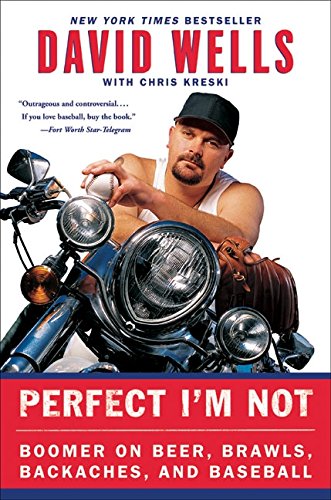
One of which is Perfect I’m Not: Boomer on Beer, Brawls, Backaches, and Baseball by David Wells.

WellsTwo thirds of the way through it and I will tell you this.  Imagine yourself in a bar, throwing back mugs of beer and shots and sitting at a table with Wells.  He tells you one baseball story after another not giving a damn who is listening.  That is this book.  It has its fair share of mundane descriptions of some games, et al.  That said, it is hard to read a baseball book without it (although Molina did an exceptional job of that).

Next on the nightstand after Boomer?

Where Nobody Knows Your Name: Life in the Minor Leagues of Baseball by John Feinstein and The 33-Year-Old Rookie: How I Finally Made it to the Big Leagues After Eleven Years in the Minors by Chris Coste

I do love this game. Can ya tell?

The Perfect Book Group Experience

Three people.  Three books.  Couple bottles of wine.  An indescribably sumptuous chorizo meatloaf with Manchego cheese.. A spirited and engaging discussion.  All this came together one night this past week and made for the perfect book group.

Our friend Evy joined Stacy and I in reading and discussing Hillbilly Elegy by J.D. Vance, The Curious Charms of Arthur Pepper by Phaedra Patrick and The Winter in Anna by Reed Kiram.  Three books.  One month.  All worth our while.

In Hillbilly Elegy we chatted about Vance’s exploration of the Rust Belt culture, white working-class Americans, social and class declines, and the critical role family and loyalty played in his life.  Mind you, by no means can I wax eloquent on the topic, but I can say I walked away with a much better understanding of that world than I did when I started.  Will this inspire me to learn more about it, to become more socially conscious? Perhaps, but if I am being fair, it is not likely.  I have a number of personal causes I contribute to financially and emotionally.  I am not prepared to take on another.
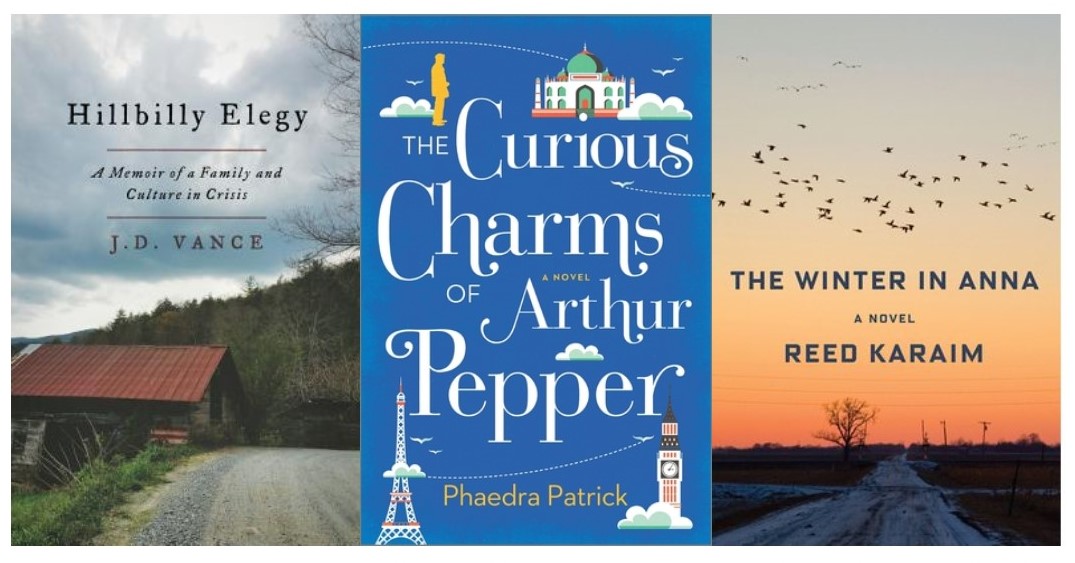
bookclubMarchBooks

It took us about 20 minutes of discussion to cover all we needed to.  As good as it was to read, and interesting as it was to learn about, it did not really move any of us.  At the same time, we were glad we invested the time in reading it.  I am not sure if that makes the right amount of sense, but either way, it is no less true.

The Curious Charms of Arthur Pepper garnered a bit more energy to the group dialogue.

Our titled protagonist was as charming as the jewelry that hung from his now deceased wife’s bracelet.  The people he met, the adventures he went on, the discovery of this life lived before he and his wife met.  All of it made for a fun read.  Yes, predictable at times, but not unforgivably so.

There is something special about a story of someone in the autumn of their years that I love.  It could be the look back.  It could be that I see them just as flawed as any of us.  It could be because they were young once too, with their own plans and schemes all lined up for their life, and nothing went they way they expected it.  That always triggers a bit of a crooked smile in me when I read it.  But above all else I love how there is a deep and loving kindness in their hearts.  They may not have seen it all, but they’ve seen a great deal, and with that comes a peace and wisdom I find myself craving as a middle-aged man.

Yes.  I liked The Curious Charms of Arthur Pepper … mostly because of Arthur himself. Such a dear man.

Then….it came.  The discussion that took us twice as long as any other.  Impassioned.  Frustrated.  Understanding.  Thoughtful.  Did I say frustrated?  Reed Karaim’s The Winter in Anna.

It’s the story of a woman, narrated by a man she knew and called friend. It opens with her death, a horrific and body shuddering suicide in a motel room and ends with a better understanding of why.  

It was dark.  I often thought of the writer at his computer or typewriter and imagined the depths of pain and darkness he slipped into in order to write something so tragically compelling.  I wondered how hard it must have been to climb out of that same darkness and resume a normal life when it was time for dinner and time to socialize with flesh and blood human beings in his presence.  Man, how do you flip that switch?  Or do you not and your family needs to cope and accept you as is?

I digress, but, I did love it.  I truly loved it.  It did what I want every piece of fiction to do when I read it.  Make me think it is non fiction.

Mr, Karaim nailed it for me.

Evy loved it too.  Much for the same reasons, I believe.

Stacy? Well, she repeatedly spoke of how beautiful the writing is, but how she loathed both Eric and Anna.  We agreed on our dislike of him as a young man but I felt he was likable as an adult.  She did not.  Anna drove her up a tree.  Her suicide was borderline unforgivable and aggravatingly selfish.  I cannot say too much because I don’t want to give anything away but suffice it to say what I heard was Stacy felt Anna lacked the courage she needed to do the right thing … and not choose to die.

I can understand where she is coming from.  I can.  

With your indulgence, I would like to help you understand where she is coming from, too.  Stace works with the elderly.  She has for (nearly) 19 years.  Most live with dementia.  This is a woman who fervently believes one’s life choice is their own.  She has told me a hundred times she is planning an escape route of her own if she becomes confused in her older age.  I totally get it.  Dementia and Alzheimer’s is such a destructive disease.  Stacy lives and works with it every day and has for nearly two decades.  Yes, I think she is a saint, but that’s not the point in this blog.  She is a woman who deeply understands and respects life.  She also believes it is our own to make the choices we feel is best.  If you are suffering and if you are dying or deteriorating, then the choice ought to be yours.  At least, that has always been my interpretation of her beliefs.

That was why, after reading and discussing the events of this book, that I was shocked – completely and utterly shocked – that she wasn’t nearly as forgiving of Anna as I thought she would be.

But this is why we read, isn’t it?  To be taken away? To be transported?  To give us a great story to discuss, debate and reflect on with those we connect closest with?

Yeah.  This was the perfect book group.  Such great stories.  Such compelling and heartfelt arguments.  Such a deep and fervent love of reading.  Such incredible women I surround myself with.

It’s OK to be a little envious.  Hell, if I weren’t already me, I would envy me too.  I am surrounded by really smart people with Stacy and Evy, and nothing could be more beautiful.

PS NOTE:   There is one major difference in the reading of The Winter in Anna I think is worth noting.  I read this believing the age difference between the two was eight years (Anna 29, Eric 21) while Stacy thought Anna was late 30’s early 40’s.  If I perceived the age gap that large, I would read it a little differently too.  Anna is still Anna and she owns a piece of my heart.  But my feeling(s) toward Eric likely would have changed and probably not for the better.  They would have mirrored Stacy’s more.

Next Month’s Books are:  Himself, Idaho and Lincoln in the Bardo

bookclubAprilBooks


Arthur Pepper Stands on His Own

With his beloved Miriam 12 months removed from this life and on to the next, Arthur Pepper discovers a charm bracelet he has never seen before and thus his adventure begins.

I will admit as much as I enjoyed this book – and I did, very much – there were times I found it predictable,  I also found no harm or foul in that.  Familiarity doesn’t always breed contempt and sometimes it has its place.  

I would, however, gently caution you with one thing…and this is NOT a spoiler.  When TheCuriousCharmsofArthurPepper-USAcover.jpgothers make comparisons to books like A Man Called Ove, The Unlikely Pilgrimage of Harold Fry, Lillian Boxfish Takes a Walk or the heartbreakingly beautiful novella And Every Morning the Way Home Gets Longer and Longer, it is my opinion that they shouldn’t.  I will tell you they have two things in common, which are.  (1) It is a story of someone in the autumn of their years and (2) our protagonist is a beautiful human being.

But they are different.  Ove is not Harold, nor are Lillian and Grandpa anything alike.  Same goes for Arthur.  They are all their own people, with their own set of circumstances, with their own sense of humor and troubles and family.  Outside the two similarities I noted, I think that’s about it.  

My point?  The Curious Charms of Arthur Pepper stands on its own.  The book’s author is Phaedra Patrick and this is her debut novel.

A small confession on my part, I have found after reading this I seem to be drawn to books about those who are in the twilight of their years.  Books like the ones I mentioned above always seem to occupy that same spot in my heart, and The Curious Charms of Arthur Pepper was no exception.

The short story is this: A year after a man in his late 60s has buried his wife of 40 years he comes across a charm bracelet of hers he had never seen before.  One charm leads to the next in its own way, providing vague/eerie/cryptic clues to a life before Arthur and Miriam became Arthur and Miriam.

I loved Arthur immediately.  Then I found I loved  his spirit and break from the routine as I got to know him.   I warmed at his patience in listening to others regale him with stories of this woman he spent the better part of his life with; this woman he thought he knew. This woman, the love of his life, who lived a life he never knew.

That may have been my favorite part of the book, his emotional growth.  Watching him separate himself from whom he has always been.  He became inspired by the memory of his wife.  Even at times when he seemed hesitant in wanting to know her history, he pushed to learn it anyway.  I think that was hard for him.   When he made those decisions it was if his own personal feelings no longer mattered.   Knowing more of his beloved Miriam was what he wanted  There was love, deep love, that persuaded him to reach further, and dig deeper.  I admired that in him.  He might be a bit of a stronger man than I, if I am being truthful.

A Book Group Discussion question I found asked if I were bereaved after a long marriage would I devise strategies and routines just to get through the day?  I singled out this question because I wondered the same thing as I was reading the book.

The answer is an indisputable yes.  I have already spent nearly eight years with Stacy and I have never known happiness like this in my first 40 years of living.  Give me 40 years hence with this same woman, growing together in love, friendship and companionship at the same pace we have been going at, then yes, I would lock myself away in my house too.  Like Arthur, I too would behind curtains when someone knocks at the door.  

Arthur Pepper is a fine man.  The spirit and sense of adventure his Miriam lived with as a younger woman is akin to what I see Arthur doing today in his later years.  If he is blessed to get a few experiences of travelling and adventure of his own, then all the better.  At least this way, when called to meet his maker, Arthur and Miriam will have no shortage of new topics to discuss over tea.

Come to Think of it, I Walked *Ten* Miles in Her Shoes …

Lillian Boxfish goes for a walk through New York City, New Years Eve, 1984.

That’s it.

Years ago I read and loved the Unlikely Pilgrimage of Harold Fry so when I first heard of this book my line of thinking was, well, maybe this might fall into that category of storytelling.

All in all it seems to me a pretty simple idea.

But, it’s not simple.  It is far from simple.  It is moving and it is fun and it is sweet and it is heartbreaking and it is witty and above all – like our protagonist – it is very very smart.

This is a beautiful, multilayered journey that covers two miles and 84 (85 if we are being honest) years of the life of an extraordinary woman who – for the most part – lived a full and marvelous life.

lillianboxfishbookcoverHer name is Lillian Boxfish and in the 1930’s she was the highest paid ad-writing female in America.  She met someone, fell in love, got married, and got pregnant.  Conventional thinking of the times would have you believe that is the proper order of life.  It was expected.  What was also expected was a woman leaving her job to become a mother regardless of successes, status and/or income.  Sure, she continued to write poetry, advertising copy, greeting cards, four line limericks leaving the fifth to be decided by readers and a magazine’s editor.  But in the 1930’s and 40’s a woman’s place was in the home raising her children.

Lillian was so much more than “just a mother,” and I use the word “just” with consternation as there is likely no greater role on this earth than that of a loving parent.

But Lillian was so much more than a stay at home Mom.  Hell, she was so much more than most.

My God, she was beautiful and to this day I still have no true idea of what she looks like.  Author Kathleen Rooney may have described her appearance early on but for one reason or another, it escapes me.  It is not important anyway, because all I see when I close my eyes and think of Lillian Boxfish is a brilliant, sharp witted, curious, open minded, willing and at times, a troubled soul with whom I would love to have a glass of wine with….or a bottle.

She, like all amazingly beautiful people, has a multitude of flaws.  I will not give anything away, of course, but suffice it to say there was a period in her life when she came face-to-face with a bleak moment.  As much of an impact as that time was, and how it continued to construct the person she was to become years after, she never lost that way about her.  By that, I mean there was this way where she would give you reasons to never forget her.

She was – she is – memorable.

We found this to be true in several instances.  Along this two-mile walk we meet bohemians and store clerks, chauffeurs and artists, parents-to-be and a Vietnam vet security guard; a welcoming family at dinner and a scene with three criminal’s that may be the book’s funniest moment.

Oh, I assure you, Lillian Boxfish’s walk in New York City may seem simple from the outset, and Amazon.com book summary, but it is far from it … unless you want to say it is simply lovely.  Then you would be within your rights to use an alternate form of the word.  From the time you first crack the binding open, to the moment you close the book, press it against your chest, breathe in deep, wrap your arms around it, you will find yourself so very pleases you have met, and spent this New Year’s Eve with, the remarkable – the oh so very memorable – Lillian Boxfish.

So I say buy this book.  Support this author.  This is the very reason why we read books and Lillian is someone you will want to get to know.

She is, simply, lovely.

Words I learned while reading:    One of my favorite parts of reading is constantly learning words I have either (a) never heard before (b) words I have heard and possess only a vague understanding of their meaning based on the context in which they’ve been written and (c) the most frustrating of the lot – the words I know I know the meaning of until I actually look them up to ensure I am correct only to learn I misunderstood it’s true meaning.  That last lot have an * beside them.   Here is the contribution that I received from Kathleen Rooney’s Lillian Boxfish Takes a Walk.

Contralto – the lowest female singing voice   –   Vanitas – a still-life painting of a 17th-century Dutch genre containing symbols of death or change as a reminder of their inevitability   –   Insouciance * (inˈso͞osēəns,) – casual lack of concern; indifference.    –   Stentorian – (of a person’s voice) loud and powerful.    –   Enjambments – (in verse) the continuation of a sentence without a pause beyond the end of a line, couplet, or stanza.   –   Housmanian – reference to an English classical scholar and poet.    –   Unfraught – not burdened.    –   Egalitarian – relating to or believing in the principle that all people are equal and deserve equal rights and opportunities.    –   Petulant* – (of a person or their manner) childishly sulky or bad-tempered.    –   Joie de vivre (ˌZHwä də ˈvēvrə/)* – exuberant enjoyment of life.   –   Oleaginous (ˌōlēˈajənəs)- rich in, covered with, or producing oil; oily or greasy AND exaggeratedly and distastefully complimentary; obsequious.  “Candidates made the usual oleaginous speeches in the debate.”    –   Poniard (ˈpänyərd/) – a small, slim dagger.    –   Endemic* – (of a disease or condition) regularly found among particular people or in a certain area. “Areas where malaria is endemic.”    –   Flanerie (ˌflän(ə)ˈrē/) – aimless idle behavior.